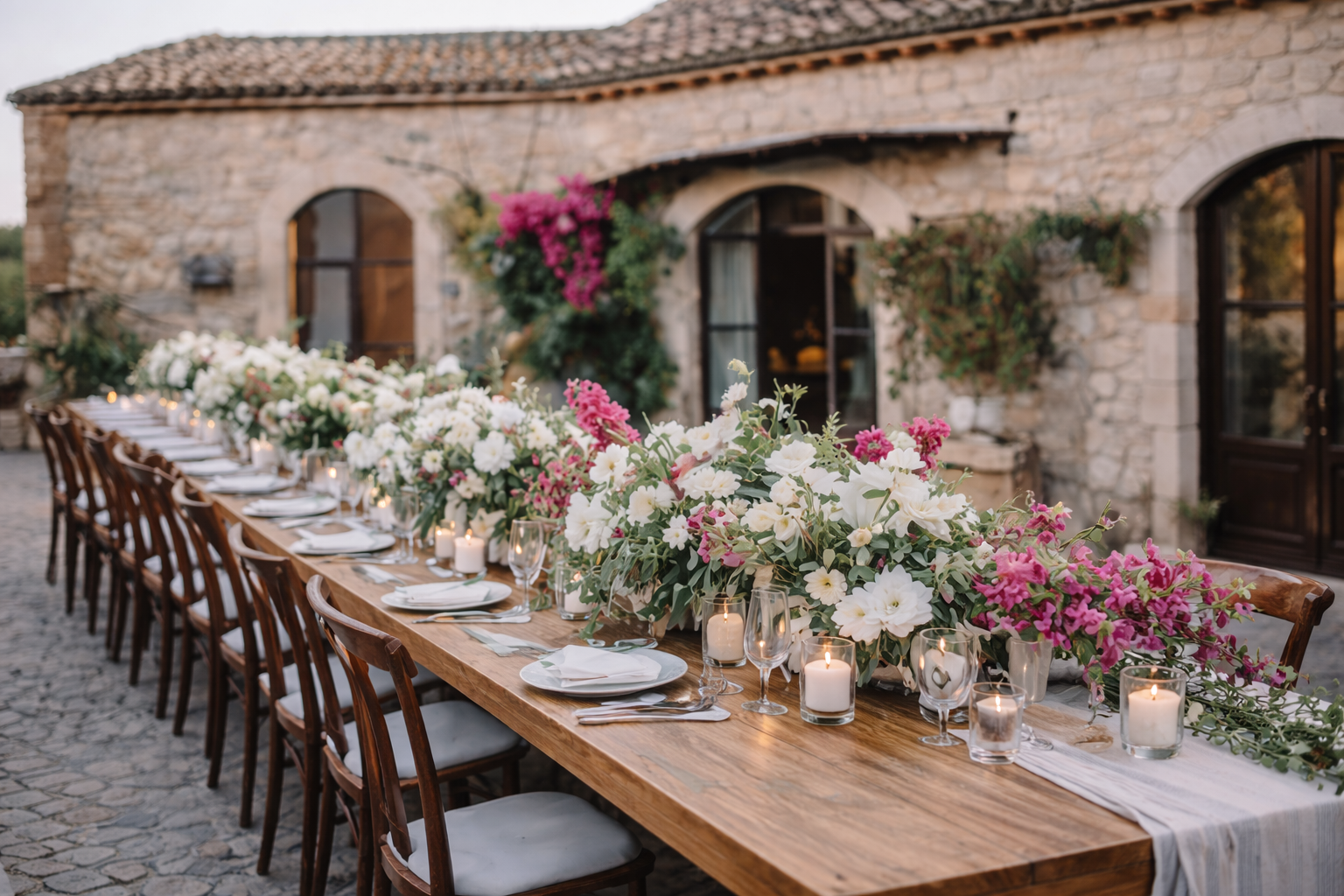
In Sicily, flowers are not a theme. They are a coherence choice. Coherence with the month, with the exposure of the venue, with wind, with proximity to the sea, with the distance between ceremony and reception, with how many hours the arrangements need to hold without turning into an operational problem. This is often treated as style, but here more than elsewhere it is behaviour.
Seasonality is not an abstract principle. It’s a practical reality. In some periods flowers work with you; in others they force you to compensate. Those compensations are not only financial, they are logistical: tighter set-up windows, real shade to find, more delicate transport, arrangements that need protection until the last possible moment. When a wedding needs to be constantly managed, the rhythm changes. And rhythm is what remains in memory far more than any palette.
For that reason, the decision shouldn’t start from a specific flower seen elsewhere. It should start from the period and the conditions. In Sicily you can source almost anything, but available doesn’t mean sensible. The useful question is not whether a flower exists, but how it holds, how believable it is in that context, and how much attention it demands inside a day that already has many moving parts. In other words, flowers shouldn’t be chosen to “look good in a photo”. They should be chosen to last for hours, through changing light, air, and the long stretch of a reception.
During the shoulder months, the ones that tend to make the whole day easier, floral choices become more natural as well. May and June, then September and the first half of October, allow fuller arrangements without turning them into fragile objects. In that window, what often works well are solid choices, not because they’re “safe” in a generic sense, but because they hold: roses (including garden varieties), lisianthus, gypsophila, together with structural greens like eucalyptus and Mediterranean foliage. If a couple wants a flower that is truly tied to a narrow seasonal moment, peonies only make sense when the timing supports them; that is precisely why they have value when they are not forced.
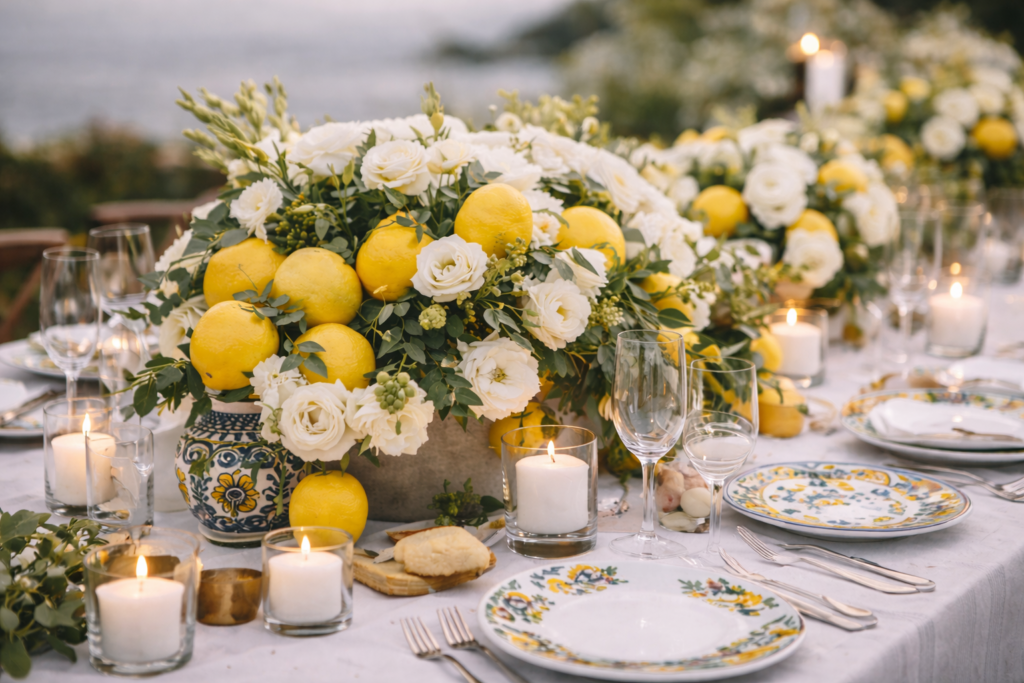
September and October also allow a more textural language and a less “spring-like” feel. Dahlias and amaranthus, in this sense, are often more convincing than imported solutions chosen by imitation, because they belong to a more mature period of the year and they support a deeper, quieter aesthetic.
October, in particular, opens a possibility that is less credible in other months: working not only with flowers, but with matter. Pumpkins, pomegranates, prickly pears, grapes, branches, leaves can enter arrangements as structure, not as decoration. The difference is always restraint: not building a set, but building coherence.
High summer is a different conversation, not because it cannot be done, but because it reduces the margin. July and August require you to reverse the priority: staying power first, everything else after. In those months the decisive factor is less “the right variety” and more the way the arrangements are built and how exposed they are. In hot, windy settings or near the sea, compositions that do not depend only on petals tend to hold better, with more structure and less fragility. Practically speaking, flowers like orchids, lisianthus and spray roses, combined with a higher share of greens and material, are often more reliable than choices that require cool air and constant shade. If an arrangement must sit in direct sun, it will pay a price. In Sicily that price arrives quickly.
Winter and early spring change the frame for a simple reason: spaces and light often change too. More interiors, more contained timing, more control. Here the strongest choice is rarely to add; it is to reduce, letting materials, light and proportion do the work. The typical mistake is to overload because it’s cooler, as if decoration had to compensate for atmosphere. In reality it’s the opposite: coherence in these months is precision, not volume.
There are also elements that make sense in Sicily only if they are not treated as symbols. Orange blossom, when it is its moment, works as a discreet accent, sometimes minimal, more for presence and memory than for quantity. Bougainvillea, if the venue already has it, is often better left as natural scenery than chased inside artificial compositions. Prickly pear fruit and cactus structure can read as a real signature in coastal contexts precisely because they belong to the landscape, and for that reason they should be used with restraint. Sicily becomes folkloric when it is performed as a theme; it becomes believable when it is respected as context.
If you are planning from abroad, the most useful thing is not learning ten flower names. It is setting the conversation with your florist in the right order. Month and time of day, indoor or outdoor, wind exposure, proximity to the sea, distances between locations, reception duration and set-up constraints. Conditions first, style after. In Sicily, when that order is respected, flowers stop being an uncertainty and become a natural consequence. And in a wedding, natural consequences are almost always the ones that hold best.